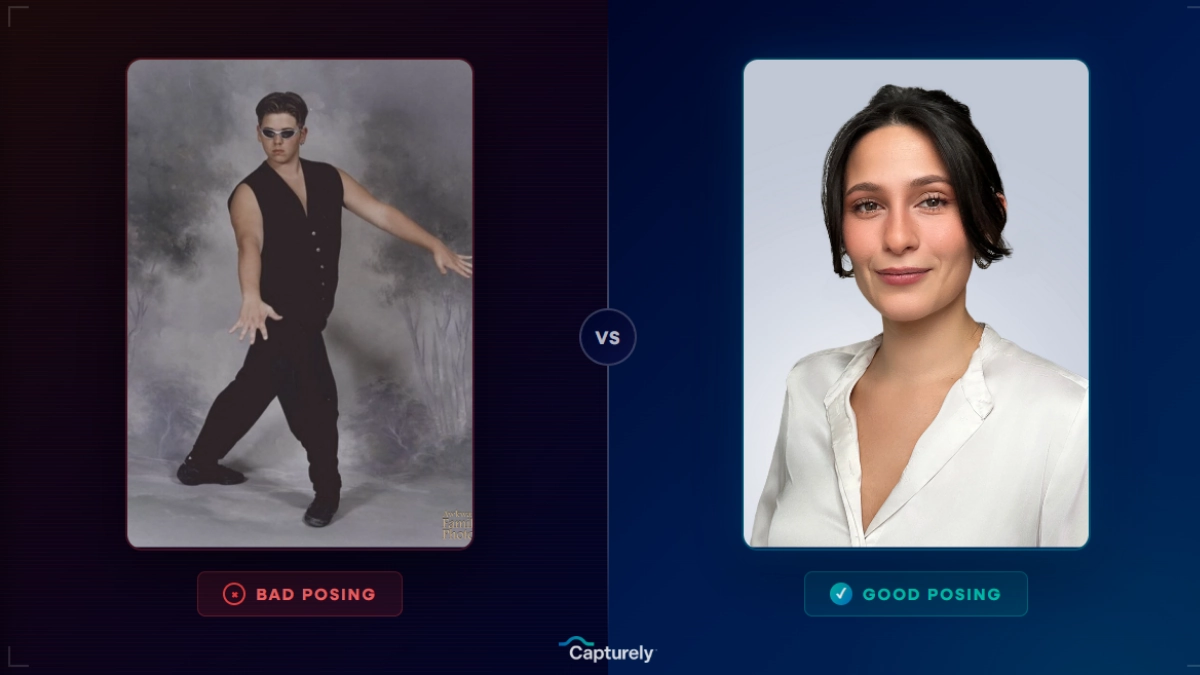
Your corporate headshot pose communicates authority, approachability, or awkwardness — and viewers decide which one in under a second.
The best way to pose for corporate headshots: angle your body 30-45 degrees from the camera, push your chin slightly forward and down, drop your shoulders, lean fractionally toward the lens, and make direct eye contact with the camera — not the screen. These five adjustments account for most of the difference between a headshot that builds trust and one people scroll past without a second thought.
Last updated: February 2026
This guide covers every corporate headshot pose worth knowing — the specific angles, micro-adjustments, and expression techniques that professional photographers coach during sessions. The same direction Capturely’s photographers deliver in real time during 10-minute virtual sessions, broken down so you can apply it whether you’re directing yourself or working with a pro. We’ll cover what works, what to avoid by industry, and why posing is the one variable that better lighting and a nicer camera can’t fix on their own.

Why Your Corporate Headshot Pose Matters More Than Your Camera
Princeton researchers Alexander Todorov and Janine Willis found that people form trustworthiness judgments from a face in 100 milliseconds — one-tenth of a second (Psychological Science, 2006). Your corporate headshot gets less time than a blink to land its message.
And that message isn’t random. It’s driven by specific visual cues — facial angle, expression, posture, eye direction. Get them right and you look competent, trustworthy, approachable. Get them wrong and you look stiff, uncomfortable, or worse — unapproachable. The camera doesn’t lie. But it doesn’t flatter either.

LinkedIn profiles with professional headshots receive 14x more views and 36x more messages than those without (LinkedIn, 2023). But “professional” doesn’t just mean good lighting. It means a pose that signals both competence and warmth — what social psychologists call the two-factor model of person perception. PhotoFeeler’s analysis of 60,000+ headshot ratings found that specific posing techniques produce measurable gains: a smile showing teeth increases perceived likability by +1.35 on their scale, while the “squinch” technique boosts perceived competence by +0.33 and influence by +0.37 (PhotoFeeler, 2015). Small adjustments, big numbers.
Eighty percent of clients and partners research your team online before meetings. Your headshot is doing a job interview on your behalf, every single day, in places you’ll never see. The pose you choose determines whether it passes.
The 5 Best Poses for Professional Headshots
These are the foundational poses professional photographers use most. Master any two and you’ll have a corporate headshot that works across LinkedIn, your company website, email signatures, and provider directories.
1. The Three-Quarter Turn
Turn your body 30-45 degrees away from the camera, then rotate your head back to face the lens. This is the single most universally flattering headshot pose because it creates depth, slims the torso, and introduces natural asymmetry — the same thing that makes candid photos look better than passport photos.
Almost every professional headshot you’ve admired uses some version of this angle. It works for every face shape, every industry, every body type. If you learn one pose, make it this one.

2. The Direct Face
Straight-on to the camera. Chin slightly forward. Shoulders squared but relaxed. This pose reads as confident, authoritative, and direct — which is why it dominates attorney directories, C-suite pages, and leadership team photos. The risk: without a genuine expression, it can tip from “confident” into “intimidating.” Pair it with a slight smile or the “squinch” technique (more on that below).
3. The Slight Lean
From any base position, lean your upper body fractionally toward the camera — maybe an inch. This micro-adjustment signals engagement and approachability. Leaning back — even by a degree — reads as disinterested or guarded. The lean is subtle enough that most people can’t articulate why the photo feels friendlier. But they feel it.
4. The Relaxed Cross
For waist-up framing: arms crossed, but loosely. Forearms resting on each other, not hands gripping biceps. This pose works in tech, consulting, and creative industries where you want to project confidence without formality. The key word is “relaxed.” Tight crossed arms read as defensive. Open, loose arms read as self-assured. There’s a canyon between the two.
5. The Angled Shoulder Drop
One shoulder slightly lower than the other — the shoulder closest to the camera drops a fraction. Combined with the three-quarter turn, this creates a diagonal line that draws the eye up toward your face. Fashion and editorial photographers use this constantly. In corporate headshots, it adds a subtle dynamism that prevents the image from looking like a DMV photo.

Want a photographer to coach you through these poses in real time? Capturely’s live virtual sessions guide your posture, expression, and angles — all from your phone, in 10 minutes. Companies like Google, McKinsey, and UnitedHealth Group use it for their teams. Get your free instant quote →
The Micro-Adjustments That Separate Good Poses from Great Ones
The five poses above are the skeleton. These micro-adjustments are the muscle. Professional headshot photographers spend most of their coaching time on these details — they’re invisible to the subject but obvious in the final photo.
Chin Position: The “Turtle” Technique
Push your chin forward and slightly down toward the camera. Photographer Peter Hurley, whose headshot technique has been featured at Google, Apple, and TEDx, calls this “the turtle” — imagine your head sliding forward on your neck like a turtle poking out of its shell. It defines the jawline, eliminates the soft under-chin area, and creates separation between your face and neck. Portrait photographer Sue Bryce, founder of The Portrait Masters, reports saying “chin forward and down” a thousand times per shoot — it’s that fundamental. As she puts it: “Pushing the chin forward flatters everybody.”
The most common mistake: tilting the chin up. It feels like you’re projecting confidence. On camera, you’re projecting your nostrils. Forward and slightly down. Every time.
Shoulder Control
Right now, your shoulders are probably slightly elevated from tension. In front of a camera, they’ll be worse. Consciously pull them down and back before every shot. Tense shoulders make you look uncomfortable — because you are.
Professional photographers say “drop your shoulders” roughly every 30 seconds during a session. It’s the single most-repeated direction in headshot photography, because shoulders creep back up the moment you stop thinking about them.
The “Squinch”
Peter Hurley coined this term and demonstrated it in a TEDx talk that’s been viewed millions of times. Instead of opening your eyes wide (which reads as surprised or anxious), narrow your lower eyelids very slightly — like you’re about to smile with just your eyes. It conveys confidence and warmth without requiring a full smile.
According to Hurley: “Confidence is squinching. The opposite of confidence is the deer-in-the-headlights look, which is when you raise the lower lid.” It takes practice. Try it in a mirror. You’ll know when you’ve found it — your reflection will suddenly look more self-assured.

Eye Contact with the Lens
Look directly into the camera lens. Not at your reflection on the screen. Not at the phone’s edge. Into the actual lens. This creates the “eye contact” effect that makes viewers feel like you’re looking at them. It feels unnatural. It works. Every single time.
When a photographer is directing your session, they’ll tell you exactly where to look — and they’ll catch the split-second your eyes drift. That’s one of the things you physically cannot correct when shooting alone.
Hand Placement
For standard corporate headshots (head and shoulders framing), your hands shouldn’t be visible. For wider framing:
- One hand in pocket: Works. Conveys ease. Don’t shove the whole hand in — thumb hooked on the edge looks more natural.
- Loosely crossed arms: Works if relaxed (see pose #4 above).
- Hands at sides: Feels awkward, looks fine. Slightly bend the fingers so they don’t look rigid.
- Avoid: Hand on chin (“the thinker” looks staged), both hands in pockets (too casual for corporate), clasped hands in front (reads as nervous).
How to Pose for Corporate Headshots by Industry
The “right” pose depends on context. An attorney’s headshot shouldn’t look like a startup founder’s, and a healthcare provider’s shouldn’t look like either. Here’s what works by industry — based on what actually appears on top-performing company team pages and provider directories.
| Industry | Best Poses | Expression | What to Avoid |
|---|---|---|---|
| Finance / Law | Direct face or slight three-quarter. Squared shoulders. | Confident, minimal smile or squinch. Authority-first. | Too-casual posing, big smiles, crossed arms. |
| Healthcare | Three-quarter turn with slight head tilt. Soft lean forward. | Warm, genuine smile. Approachability matters most. | Stiff formality, intimidating direct stare. |
| Tech / Startup | Relaxed three-quarter. Relaxed cross or one hand in pocket. | Natural smile, relaxed energy. Smart and approachable. | Over-formal stiffness, corporate suit energy. |
| Consulting / Professional Services | Three-quarter turn, slight lean. Classic and polished. | Balanced — confident but not cold. Slight smile. | Overly casual, personality-forward poses. |
| Real Estate | Three-quarter turn, open posture. Wider framing OK. | Big, genuine smile. Warmth and trustworthiness. | Cold or corporate-looking, stiff crossed arms. |
| Creative / Media | Personality-forward. Slight head tilt, angled shoulder drop. | Range — from serious/editorial to warm/energetic. | Looking like a stock photo. Playing it too safe. |
One thing every industry shares: consistency matters more than individual perfection. When your team page has 15 people in 15 different poses, backgrounds, and styles, it undermines the professional image no matter how good the individual photos are. That’s why organizations like Amazon, Capital One, and Paramount use a single vendor to ensure every headshot matches — regardless of which photographer directed the session or where the employee was located. For a deeper look at managing this at scale, see our corporate headshots guide.

Corporate Headshot Expressions: How to Look Natural on Command
Posing your body is the easier part. Posing your face is where 87% of people struggle — the same percentage who don’t consider themselves photogenic (Saint Joseph’s University, 2022). Here’s what actually works.
The Memory Technique
Right before the shutter clicks, recall something genuinely funny. Not “think happy thoughts” — recall a specific moment. The difference matters physiologically. A real smile (called a Duchenne smile, identified by French neurologist Guillaume Duchenne in 1862) engages the orbicularis oculi muscles around your eyes. A forced smile doesn’t. Viewers detect the difference in under a second, even when they can’t explain why (Emotion, 2009).
The Exhale
Take a deep breath in. Let it all out. At the very bottom of that exhale, your face naturally relaxes — jaw unclenches, forehead smooths, lips soften. That’s the moment for the shot. Professional photographers time their clicks to the exhale. It’s not mystical. It’s muscle physiology.
The Warm-Up
Don’t try to nail the shot on frame one. Spend the first 2-3 minutes getting comfortable with the camera being there. Take throwaway photos. Make a ridiculous face. Get the self-consciousness out. Capturely’s photographers do this with every subject — the first few minutes are conversation and low-pressure clicks. The real headshot comes once you stop trying so hard.
Movement Between Shots
Static posing creates stiff photos. Between shots, roll your shoulders. Shake out your hands. Turn your head away, then back. Small movements prevent your muscles from locking and your expression from flattening into what photographers call “dead face” — the frozen look of someone who’s been holding a pose too long.

7 Corporate Headshot Poses to Avoid
After delivering 100,000+ headshots for companies like Google, Netflix, EY, and Deloitte, Capturely’s photography team has seen every mistake. These are the poses that consistently undermine the photos they’re meant to improve.
- Chin up. You think you’re projecting confidence. The camera sees nostrils and condescension. Push the chin forward and slightly down instead.
- The dead-on stare. Squared shoulders, eyes wide, zero expression. You’re going for “executive.” The result is “mugshot.” Add a slight angle or a squinch to humanize it.
- Death-grip crossed arms. Hands clamped on biceps, elbows tight. This reads as defensive and closed. If you’re crossing arms, keep them loose — forearms resting, not gripping.
- The hand-on-chin thinker. It looks staged in a corporate context. Save it for editorial features or book jacket photos. Not your company directory.
- Looking away from the camera. Works for acting headshots. Kills a corporate headshot. Your professional profile photo needs eye contact with whoever is viewing it.
- Extreme head tilt. A 5-degree tilt signals warmth. A 15-degree tilt signals “confused puppy.” The margin is smaller than you think.
- The stiff soldier. Arms pinned at your sides, shoulders up, body perfectly squared. You look like you’re being held at gunpoint. Introduce any angle — a slight turn, a dropped shoulder, a shifted weight — and the whole photo transforms.

What Your Photographer Will Tell You (That You Can’t Tell Yourself)
Here’s the honest truth about corporate headshot posing: the tips in this guide will take you 80% of the way. The last 20% requires someone who can see what you look like in real time — because you can’t.
A professional photographer sees things you physically cannot detect about yourself mid-pose:
- That your jaw is clenched (you feel fine — it’s visible in the photo)
- That a shadow just fell across your left eye
- That your smile is showing tension in your forehead
- That your shoulders crept up again (they do it every 30 seconds under stress)
- That turning your head two degrees to the right catches the light better
These micro-corrections — each taking less than a second to coach — are the gap between an OK headshot and one that makes people trust you before reading a word you’ve written.

The traditional way to get this direction was booking a studio — $150-$450 per person, plus travel and scheduling logistics. For distributed teams, that means coordinating photographers across multiple cities and hoping for consistent results. They rarely are.
Capturely’s virtual model works differently. A professional photographer connects through your phone — like a video call. They switch you to the rear camera (36-48 megapixels), then spend about 10 minutes coaching your entire pose: body angle, chin position, shoulder tension, expression, eye contact. They tell you when to breathe. They catch the moments between “tries” that are often the best frames. Everything in this guide, delivered in real time by someone who does it thousands of times a year.
The result: studio-quality corporate headshots taken from wherever you are, delivered within 24 hours with professional retouching. No app download. No travel. That’s how companies like Google, Netflix, EY, and Deloitte get consistent headshots for distributed teams — without the coordination nightmare that makes everyone dread photo day.

Skip the guesswork. Capturely’s live photographers coach your pose, expression, and angles — all from your phone, in 10 minutes. 765+ reviews at 4.9 stars. $79/session individual, teams save up to 45%. Get your free instant quote →
How to Prepare for Your Corporate Headshot Pose
These steps set you up for a better result regardless of whether you’re directing yourself or working with a photographer.
- Practice your three-quarter turn in a mirror. Find the angle where your jawline looks strongest. Most people have a “good side” — one direction where the three-quarter turn is more flattering. A photographer will find this in seconds. Solo, you’ll need 5 minutes of mirror time.
- Practice the chin push. Forward and down. Move through the range of chin positions until you find the one that defines your jawline without looking intense. Take a photo at each position. Compare.
- Warm up your face. Exaggerate facial expressions for 60 seconds before the session — big smile, big frown, raise your eyebrows, scrunch your nose. This loosens the facial muscles the same way stretching loosens your legs before a run.
- Wear the right outfit. Solid colors photograph better than patterns. Navy, charcoal, and jewel tones work across industries. Iron everything — wrinkles show up worse on camera. For a detailed guide by industry, see what to wear for professional headshots.
- Eat something. Low blood sugar equals flat expression. A headshot session isn’t long, but your face shows fatigue faster than you think.
For a complete preparation guide covering lighting, camera setup, and editing, check out our post on how to take professional headshots.

Need consistent headshots for your team? Capturely handles everything — posing, lighting, expression coaching — for distributed teams from 5 to 5,000+. 24-hour delivery. 98+ backgrounds. Same consistent look across every person. See team pricing →
Frequently Asked Questions
What is the best pose for a corporate headshot?
The three-quarter turn — body angled 30-45 degrees from the camera with your head rotated back to face the lens — is the most universally flattering corporate headshot pose. Combine it with a chin pushed slightly forward and down, dropped shoulders, and a slight forward lean. This creates depth, defines the jawline, and works for every face shape and industry context.
Should you smile in a corporate headshot?
Yes, in most industries — but authentically. A genuine Duchenne smile (engaging muscles around both mouth and eyes) increases perceived warmth and competence simultaneously. For finance, law, and executive contexts, a confident “squinch” with slightly parted lips can project authority without coldness. Forced smiles are detected subconsciously by viewers in under a second (Psychological Science, 2006).
How do you avoid a double chin in headshots?
Push your chin forward and slightly down toward the camera — the “turtle” technique coined by photographer Peter Hurley. This extends the neck, defines the jawline, and creates separation between chin and neck. The common mistake is tilting the chin up, which actually accentuates the under-chin area. Professional photographers coach this adjustment within seconds of starting a session.
Should arms be crossed in a corporate headshot?
Crossed arms work in tech, consulting, and creative industries if they’re relaxed — forearms resting gently, not hands gripping biceps. For standard head-and-shoulders framing, arms shouldn’t be visible. In wider framing, one hand in a pocket or arms naturally at your sides are safer alternatives that avoid the defensive signal tight crossed arms can send to viewers.
What is the “squinch” in headshot photography?
The squinch is a technique where you narrow your lower eyelids very slightly — as if you’re about to smile with just your eyes. Coined by photographer Peter Hurley, it replaces the wide-eyed “deer in headlights” look with confident, engaged eye contact. The adjustment is subtle: too much and you’re squinting, too little and you look startled. Practice in a mirror until your reflection shifts from anxious to self-assured.
How should men and women pose differently for corporate headshots?
The differences are minimal in corporate context. Both benefit from the three-quarter turn, chin-forward technique, and dropped shoulders. Men tend to look strongest with squared or slightly angled shoulders for authority. Women often benefit from a slightly more angled shoulder line for a dynamic look. The expression matters more than gender-specific posing — genuine warmth and confidence read well regardless of who’s in front of the camera.
Can I get a good corporate headshot posing by myself?
You can get a decent result with the techniques in this guide. The limitation is self-direction — you can’t see your own chin angle, shoulder tension, or shadow placement while the photo is being taken. Photographer-directed headshots consistently score higher for competence and likability because someone else catches what you miss. Virtual sessions with a live photographer bridge that gap without requiring studio visits or travel.
How often should corporate headshots be updated?
Every two to three years, or whenever your appearance changes noticeably — new hairstyle, glasses, significant weight change. An outdated headshot creates a trust gap when colleagues and clients see you on video calls and don’t recognize you from your photo. For teams, setting a regular refresh cycle keeps your directory current without annual scrambles to coordinate photo days across offices.
For a complete overview of professional headshot types, costs, and options, read our professional headshots guide. For wardrobe guidance, see what to wear for professional headshots.