A school photography RFP shouldn’t take weeks to write. But if you’ve ever tried to draft one from scratch, you know the reality — you end up Googling other districts’ RFPs, copy-pasting sections that don’t quite fit, and hoping you didn’t miss something important. Most school photography RFPs we’ve reviewed are missing entire categories of evaluation criteria. Privacy requirements. Technology standards. Parent experience metrics. Scoring rubrics that actually produce a defensible vendor decision.
Last updated: March 15, 2026 · Written by Brian Confer, Co-founder & COO at Capturely
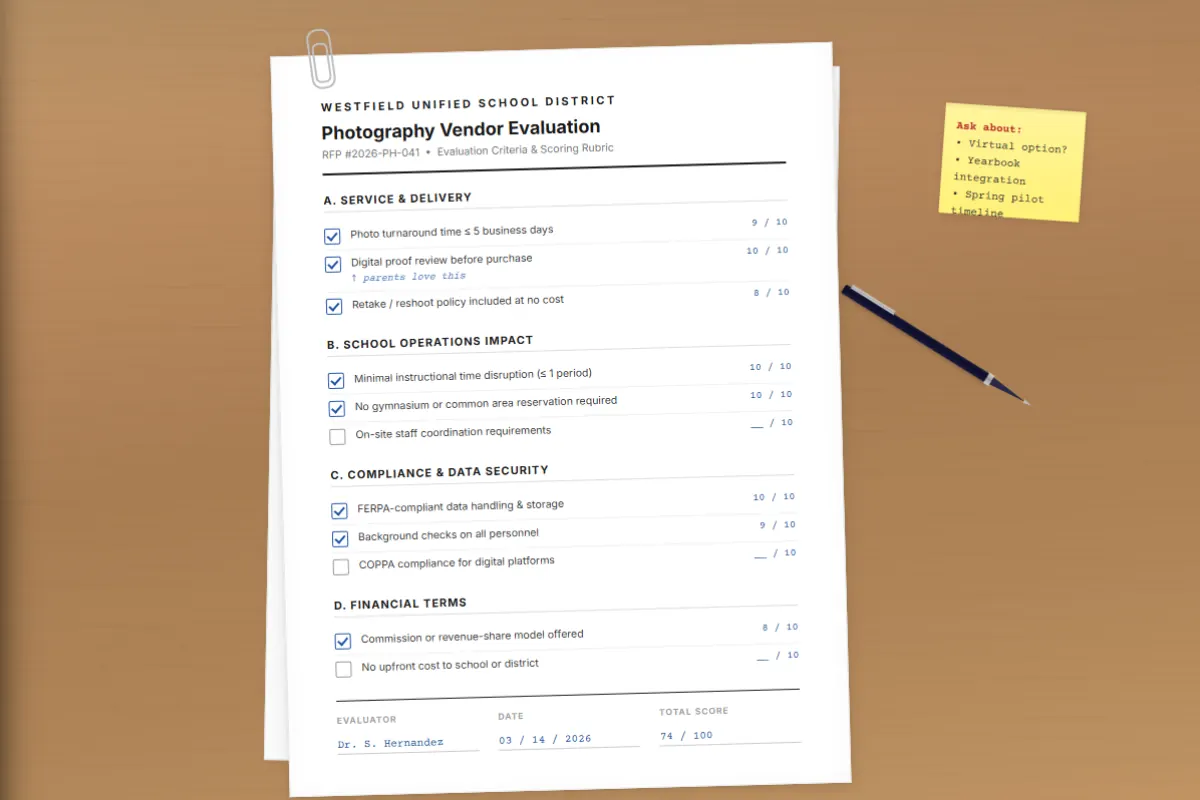
This guide gives you a complete school photography RFP template — 35+ evaluation criteria organized into seven categories, a weighted scoring rubric, and 20 questions to ask during vendor demos. It’s built from analysis of real district RFPs issued in 2024-2025, procurement best practices, and the specific challenges schools face when evaluating photography vendors in 2026.
Whether you’re replacing a vendor mid-contract, issuing your first formal RFP, or tightening up a process that’s been informal for years, this template covers what most districts miss.
Why Schools Need a Formal Photography RFP
Most school photography contracts aren’t awarded through formal procurement. A principal gets a pitch from a vendor, likes the sample photos, checks that the commission rate is reasonable, and signs. It works — until it doesn’t. Until the vendor’s quality drops, or delivery takes six weeks, or parents start asking questions about who has access to their children’s photos.

A formal RFP forces you to define what you actually need before vendors start selling. It creates a paper trail for your board. It gives you a structured way to compare three or four options side by side, using criteria that matter — not just whoever has the best sales pitch.
When to Issue an RFP vs. Direct Contract
Not every school needs a formal RFP. Here’s when it makes sense:
- District-level contracts covering multiple buildings — the procurement threshold in most states requires competitive bidding for contracts above $25,000-$60,000, though photography contracts often fall below this since schools don’t pay upfront.
- Replacing a long-term vendor — if you’ve been with the same company for five or more years, a formal evaluation protects you from defaulting to the familiar option.
- Board or community scrutiny — when parents, board members, or media are paying attention to vendor relationships, a documented RFP process demonstrates due diligence.
- First-time vendor selection — new schools, charter schools, or schools that previously handled photography in-house.
For individual schools with straightforward needs, a less formal process works — request proposals from three vendors, evaluate them against a checklist, and document your decision. The evaluation criteria in this guide work either way.
The Spring Decision Timeline
School photography follows a predictable calendar. Fall portraits happen in September and October. That means vendor decisions need to be finalized by May or June at the latest — and the evaluation process takes 2-4 months. If you’re reading this in spring 2026, the window is open right now.
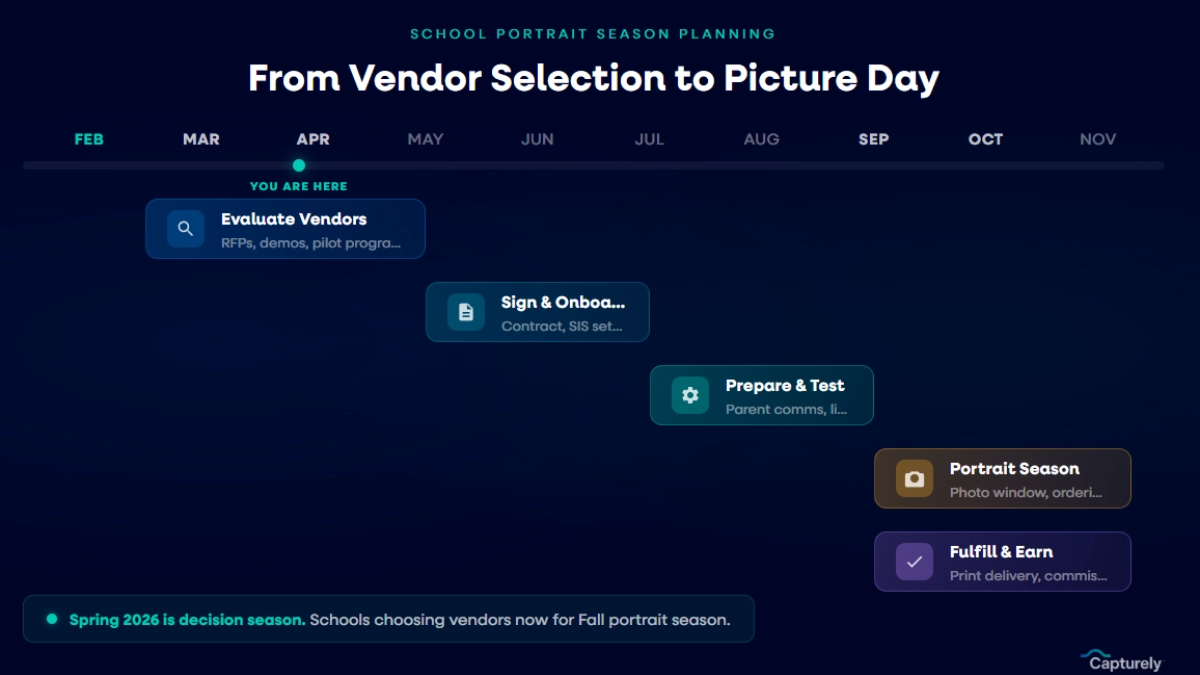
A realistic timeline:
- March-April: Draft and issue the RFP. Give vendors 30-45 days to respond.
- April-May: Review proposals, score with your rubric, conduct vendor demos or interviews.
- May-June: Run a pilot with your top candidate (photograph one grade or class at no cost). Collect parent feedback.
- June: Award the contract. Begin onboarding and parent communication for fall.
Evaluating vendors now? Capturely provides a complete RFP response package — compliance documentation, sample galleries, references, and a free pilot program for your district. Request the package →
What to Include in a School Photography RFP
We analyzed RFPs from ten school districts issued between 2023 and 2025 — West Allegheny (PA), Hatboro-Horsham (PA), Clarkston (WA), Orland SD 135 (IL), Fowlerville (MI), Manchester (CT), Anamosa (IA), Howard County (MD), and others. The best RFPs share a consistent structure, but nearly all of them have blind spots. Here’s what to include — and what most districts leave out.
Scope of Services
Define exactly what you need the vendor to provide. Be specific — vague scope leads to surprise charges and unmet expectations.
- Individual student portraits — fall and spring sessions, number of buildings, estimated student count per building
- Class and group photos — homeroom groups, grade-level composites
- Retake/makeup sessions — timeline, frequency, and whether retakes are free regardless of reason
- Sports team photography — fall, winter, and spring seasons if applicable
- Club and extracurricular group photos
- Staff headshots — if you want one vendor for both students and staff, specify this
- Yearbook deliverables — digital file format, resolution requirements, compatibility with your yearbook platform (Jostens, Walsworth, Entourage, Treering, etc.)
- Student ID card photos — format requirements, delivery timeline

Technical Requirements
This is the section most RFPs handle poorly — or skip entirely. Technology requirements separate modern vendors from those running the same playbook they used in 2010.
- Digital delivery timeline — specify maximum days from photo capture to parent access (the best vendors deliver within 24-48 hours; traditional vendors take 3-6 weeks)
- Image resolution — minimum resolution for print products and digital downloads
- Online ordering platform — must be mobile-friendly, PCI-compliant for payment processing, accessible in multiple languages if your district requires it
- Parent gallery access — proofing before purchase (see-before-you-buy), gallery duration, privacy controls
- SIS integration — can the vendor import student rosters from your student information system (PowerSchool, Infinite Campus, Skyward, Tyler SIS)?
- Yearbook platform compatibility — direct export to your yearbook vendor’s system
- Communication platform integration — ability to distribute session links through ParentSquare, Remind, ClassDojo, or your district’s existing tools
Operational Requirements
How the vendor actually delivers the service on the ground — or, in the case of newer models, how they deliver it without setting foot in your building.
- Photography model — on-site at school, at-home/virtual, or hybrid? Don’t assume on-site is the only option. Some vendors now offer fully virtual sessions that eliminate school-day disruption entirely.
- Scheduling flexibility — single-day picture day, multi-day windows, or family-scheduled sessions?
- Staffing — how many photographers per school? What is the throughput rate (students per hour)?
- Parent communication — who handles order form distribution, scheduling reminders, and customer service inquiries? Is there a toll-free customer service line?
- Retake policy — free retakes regardless of reason should be the minimum standard.
- Complaint handling — does the vendor maintain a complaint tracking log? What are response time commitments?
Privacy and Compliance
This is the section that matters most in 2026 — and the one most RFPs handle worst. Of the ten district RFPs we analyzed, only one (West Allegheny, PA) included specific data privacy language. The rest had nothing.
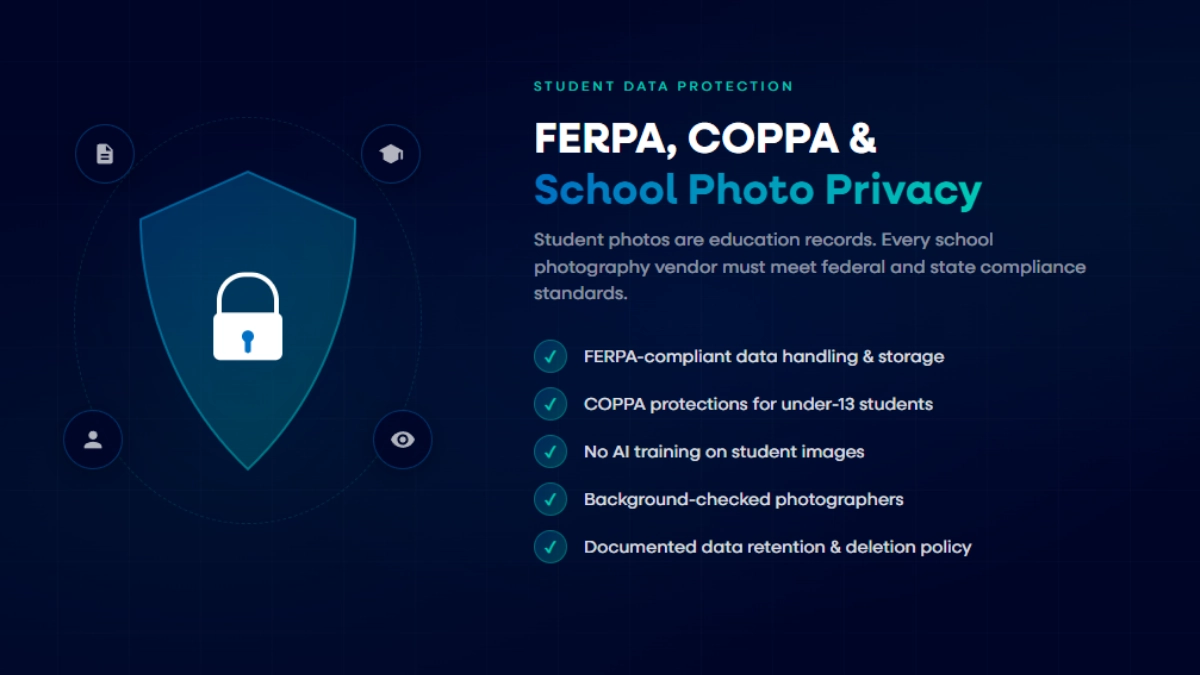
Student photos are education records under FERPA when maintained by the school or a party acting on its behalf — which includes your photography vendor. Your RFP must address:
- FERPA compliance — vendor must execute a written agreement as a “school official” under the FERPA school official exception, limiting data use to the contracted service
- COPPA compliance — especially relevant for online ordering platforms where parents of children under 13 create accounts (new COPPA rules took effect June 2025 with full compliance required by April 2026)
- Data collection limits — specify exactly what student data the vendor may collect (West Allegheny limits it to first name, last name, homeroom, and student ID — that’s the right approach)
- Data retention and destruction — how long does the vendor keep student photos after the contract ends? What is the deletion timeline and method?
- No data sales or sharing — explicit prohibition on selling, sharing, or using student data for marketing, advertising, or any purpose beyond the contracted service
- No AI training — explicit prohibition on using student photos to train AI or machine learning models
- Breach notification — if the vendor’s systems are compromised, what is the notification timeline and process?
- Background checks — requirements vary by state. Texas requires fingerprint-based checks for contractors with direct student contact. Florida requires Level II checks. Many states require checks for any adult with unsupervised access to students. Specify your state’s requirements.
- Insurance — minimum $1 million per occurrence / $2 million annual aggregate for commercial general liability. Workers’ compensation at statutory limits. Sexual abuse and molestation coverage for any vendor program involving minors. The school should be named as additional insured.
For a deep dive on FERPA, COPPA, and state-specific privacy requirements for school photography, see our complete FERPA and school photography compliance guide.
Financial Terms
The financial structure of school photography is unusual — schools don’t pay the vendor. Revenue comes from parent purchases, and schools earn commissions. Your RFP should require transparency on the full financial picture.
- Commission structure — percentage of gross sales (typical range: 15-40%), flat fee per package, or hybrid. Commissions should be calculated on gross sales before any deductions — don’t let vendors subtract processing costs or profits before calculating your share.
- Package pricing to parents — full price sheet for every package option. Include digital-only options. Require at least one budget-friendly option for families with financial constraints.
- Free services — what’s included at no cost? Yearbook photos, student ID cards, class composites, and retakes should all be free. Get it in writing.
- Hidden fees — ask explicitly about shipping charges, digital download surcharges, rush delivery fees, and retake fees. If the vendor charges parents extra for digital files, that’s a red flag in 2026.
- Payment timeline — when does the school receive commission checks? Industry standard is within 30 days of order fulfillment, with an itemized breakdown.
- Multi-year terms — contract length (1-5 years is typical, with 3-year terms most common), renewal process, and termination clauses. Include a 60-90 day cancellation notice period.
Full breakdown of school photography pricing, commission structures, and what schools actually earn.
References and Experience
- Minimum experience — 3-5 years serving schools of comparable size and demographics
- Client list — number of schools currently served, geographic coverage
- References — at least 3 current clients, including contact information for the building-level administrator (not just a district office reference). Also ask for one reference from a school that chose not to renew — this is the most revealing reference you’ll check.
- Sample work — full galleries, not cherry-picked highlights. Ask for a complete gallery from a recent session at a school similar to yours.
- Client retention rate — what percentage of schools renew year over year?
- Volume capacity — maximum students per day, maximum schools per season
School Photography RFP Template With Scoring Rubric
Here’s the part you actually need — a ready-to-use template with 35+ evaluation criteria organized into seven categories. Each category has a recommended weight. Each criterion is scored 1-5 by each evaluator. Multiply the score by the weight to get a weighted total. Highest total wins.
Copy this template, customize the weights based on your district’s priorities, and distribute to your evaluation committee.
Scoring Instructions
Scale: 1 = Does not meet requirements | 2 = Partially meets | 3 = Meets requirements | 4 = Exceeds requirements | 5 = Significantly exceeds requirements
Process: Each evaluator scores independently. Average all evaluator scores per criterion. Multiply by category weight. Sum for total score.
| Category | Weight | Criteria |
|---|---|---|
| Photo Quality & Consistency (25%) | 25% | Image resolution and clarity across sample gallery |
| Consistency across high-volume sessions (500+ students) | ||
| Retouching quality (natural, age-appropriate, preserves features) | ||
| Background variety and customization options | ||
| Lighting quality and setup consistency | ||
| Technology & Platform (20%) | 20% | Online ordering platform (mobile-friendly, intuitive) |
| Parent gallery and proof viewing before purchase | ||
| Digital delivery speed (hours vs. weeks) | ||
| SIS integration capabilities | ||
| Yearbook platform export compatibility | ||
| Pricing & Value (20%) | 20% | Package affordability for families |
| Commission rate and structure transparency | ||
| Free services included (IDs, yearbook images, retakes) | ||
| Digital-only and budget-friendly package options | ||
| No hidden fees or surcharges | ||
| Privacy & Security (15%) | 15% | FERPA compliance documentation and vendor agreement |
| Data collection limits and retention policy | ||
| Background check program for all personnel | ||
| Insurance coverage meets or exceeds minimums | ||
| Breach notification protocol | ||
| Operations & Service (10%) | 10% | Scheduling flexibility and accommodation of school calendar |
| Customer service access (phone, response time SLAs) | ||
| Retake policy (free, flexible timing) | ||
| Admin dashboard or portal for school staff | ||
| Complaint tracking and resolution process | ||
| Experience & References (5%) | 5% | Years in operation and schools currently served |
| Reference quality and retention rate | ||
| Sample gallery quality from comparable schools | ||
| Innovation & Differentiation (5%) | 5% | Alternative photography models (virtual, at-home, flexible scheduling) |
| Parent experience innovations (see-before-you-buy, fast delivery) | ||
| Reduction of school-day disruption |
Why these weights? Photo quality and technology each carry heavy weight because they directly affect parent satisfaction and purchase rates — which determines your revenue. Privacy is weighted at 15% (higher than most districts assign it) because it’s become a board-level issue in 2026. Innovation gets only 5% of the weight, but it’s there to reward vendors who offer genuinely better approaches rather than the same model every other company runs.
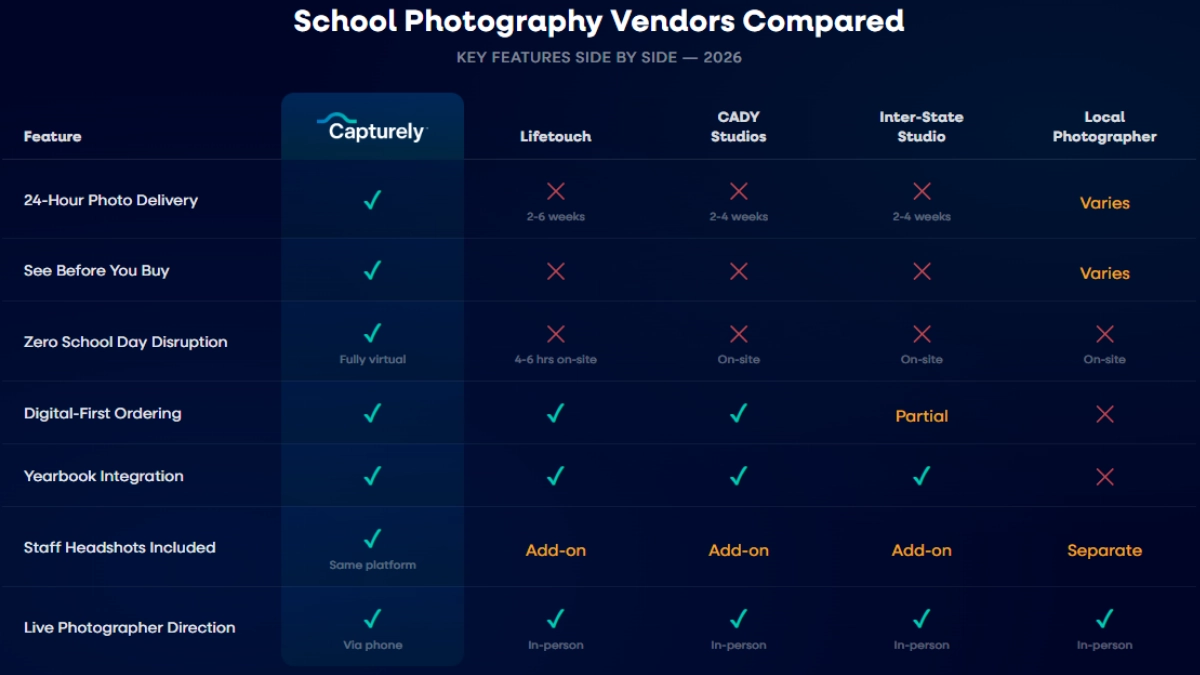
Adjust the weights based on your district’s priorities. If data privacy is your board’s top concern, bump it to 20-25% and reduce another category. If your current vendor’s biggest problem is slow delivery and outdated technology, weight Technology higher.
Evaluation Criteria That Most Schools Miss
After reviewing ten real district RFPs, a pattern emerged: schools evaluate what they can see (photo quality, pricing) but skip what they can’t (data handling, parent experience, exit planning). Here are the four criteria categories that matter most — and get ignored most.
Delivery Speed
Ask for specific SLAs, not vague promises. “Timely delivery” means nothing. “Digital proofs available to parents within 48 hours of photo capture” means something. “Print packages shipped direct-to-home within 10 business days of order” means something.
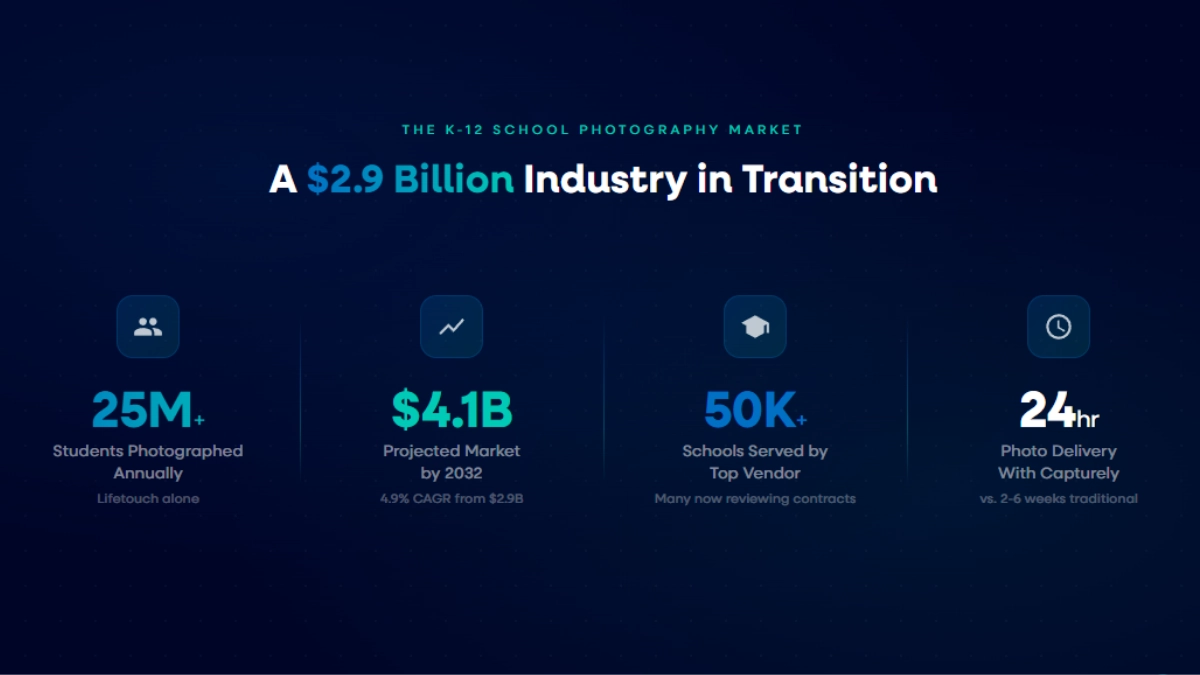
For context: parents in 2026 can order dinner on their phone and have it delivered in 20 minutes. They can buy a product on Amazon and have it tomorrow. Then their kid’s school photos arrive in an envelope three to six weeks later. Freakonomics research shows that vendor break-even requires about 30% of parents buying at $25 average — and purchase rates have been declining for decades. Faster delivery and see-before-you-buy ordering can reverse that trend, which means more commission revenue for your school.
Parent Experience
No RFP we reviewed included a single criterion about the parent experience. That’s a problem, because parents are the revenue source. If they don’t buy, nobody gets paid — not the vendor, not the school.
Include these in your evaluation:
- Can parents view photos before purchasing? (“See before you buy” is the single most-requested feature among parents.)
- Is the ordering platform mobile-friendly?
- What languages does the ordering platform support?
- Can parents buy individual photos a la carte, or are they locked into packages?
- Does the vendor offer low-cost options for families with financial constraints?
- What is the vendor’s parent satisfaction rate, and how do they measure it?

Data Privacy Practices
Don’t settle for a FERPA checkbox. Ask vendors to provide their complete data privacy policy, a sample vendor agreement addendum, and specific answers to:
- What student data do you collect? (Acceptable: name, homeroom, student ID. Unacceptable: home address, phone number, email, biometric data.)
- Where is student data stored? Is it encrypted at rest and in transit?
- Who has access to student photos within your organization?
- Do you use student photos for marketing, training AI models, or any purpose beyond fulfilling the school’s order?
- What is your data retention period, and how are photos and data destroyed when the contract ends?
- Have you experienced a data breach in the past five years?
States are tightening requirements. FERPA applies to student photos maintained by the school’s agent. Since 2014, lawmakers have introduced over 1,000 student privacy bills, passing nearly 150 laws across 47 states. California’s SOPIPA, Illinois’s SOPPA, New York’s Education Law 2-d, and Colorado’s Student Data Transparency Act all impose requirements that go beyond federal FERPA baseline. Your RFP should apply the most restrictive standard regardless of your state.
Integration Capabilities
If the vendor can’t plug into your existing systems, your staff becomes the integration layer — manually transferring rosters, reformatting yearbook files, re-entering data. Ask vendors specifically:
- Can you import student rosters directly from our SIS (name the system — PowerSchool, Infinite Campus, Skyward)?
- Can you export yearbook-ready files directly to our yearbook platform (name it — Jostens, Walsworth, Treering)?
- Can session links be distributed through our existing parent communication tool (ParentSquare, Remind, ClassDojo)?
- Do you provide a school admin dashboard for tracking session status, orders, and commissions?
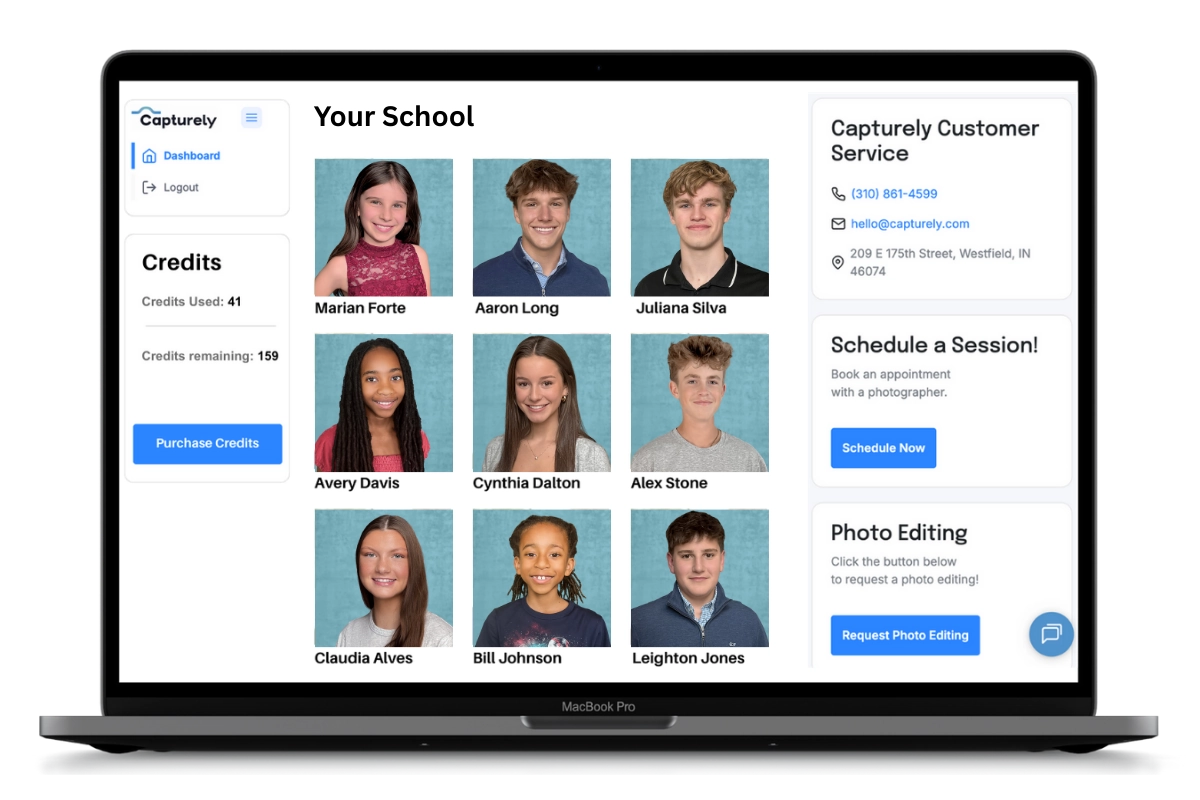
Need a benchmark? Capturely’s platform integrates with SIS systems, exports to major yearbook platforms, and provides a real-time admin dashboard for every building. See how it compares in our 2026 school photography vendor comparison. Request a demo →
20 Questions to Ask Vendors During Demos
The RFP gets you proposals on paper. The demo tells you what actually happens when families interact with the service. These are the questions that separate strong vendors from good presenters.
Photo Quality and Process
- Can you show us a complete gallery from a recent session at a school our size — not just your best shots?
- What is your retouching process? Do you use human retouchers, AI tools, or both? Can we see before/after examples?
- How do you maintain photo consistency when photographing 500+ students?
- What backgrounds do you offer, and can we customize?
- How do you handle students who are anxious, uncooperative, or have sensory sensitivities?
Technology and Parent Experience
- Can we see a live demo of your parent ordering portal on a phone?
- Do parents see their child’s actual photos before they pay?
- How quickly after the photo session can parents access their child’s gallery?
- What is your guaranteed print delivery timeline — not average, guaranteed?
- Can you integrate with our SIS to import student rosters automatically?
Privacy and Compliance
- What specific student data do you collect, and what is your retention policy?
- Can you provide a signed FERPA-compliant vendor agreement as part of the contract?
- Do you use student photos for any purpose beyond fulfilling the school’s order — including AI model training?
- What is your background check process, and how frequently are checks renewed?
- Have you experienced a data breach? What is your breach notification timeline?
Financial Transparency
- Walk us through every fee a parent might encounter — not just the base packages.
- Are retakes free regardless of reason?
- What is your commission rate, and is it calculated on gross sales before any deductions?
- Do you offer reduced-cost or free options for families with financial hardship?
- Can we contact a school that chose not to renew with you? (This is the most important reference you’ll check.)
Red Flags During Demos
Watch for these signals that a vendor may not deliver what they promise:
- Won’t show a full gallery — if they’ll only share hand-picked samples, the consistency isn’t there.
- Vague on data privacy — any hesitation about signing a FERPA-compliant vendor agreement should disqualify them.
- No phone support — email-only customer service means parents and staff can’t get help in real time on picture day or during ordering.
- Unclear pricing — if you can’t get a straight answer on every fee, parents won’t either.
- Won’t provide a non-renewal reference — every company loses clients. A vendor confident in their work should be willing to put you in touch with a school that left.
- Corporate ownership opacity — parents in 2026 are asking who owns the companies that photograph their children. If a vendor can’t clearly explain their ownership structure, that’s a problem your board will hear about.
Running a Pilot Before Committing
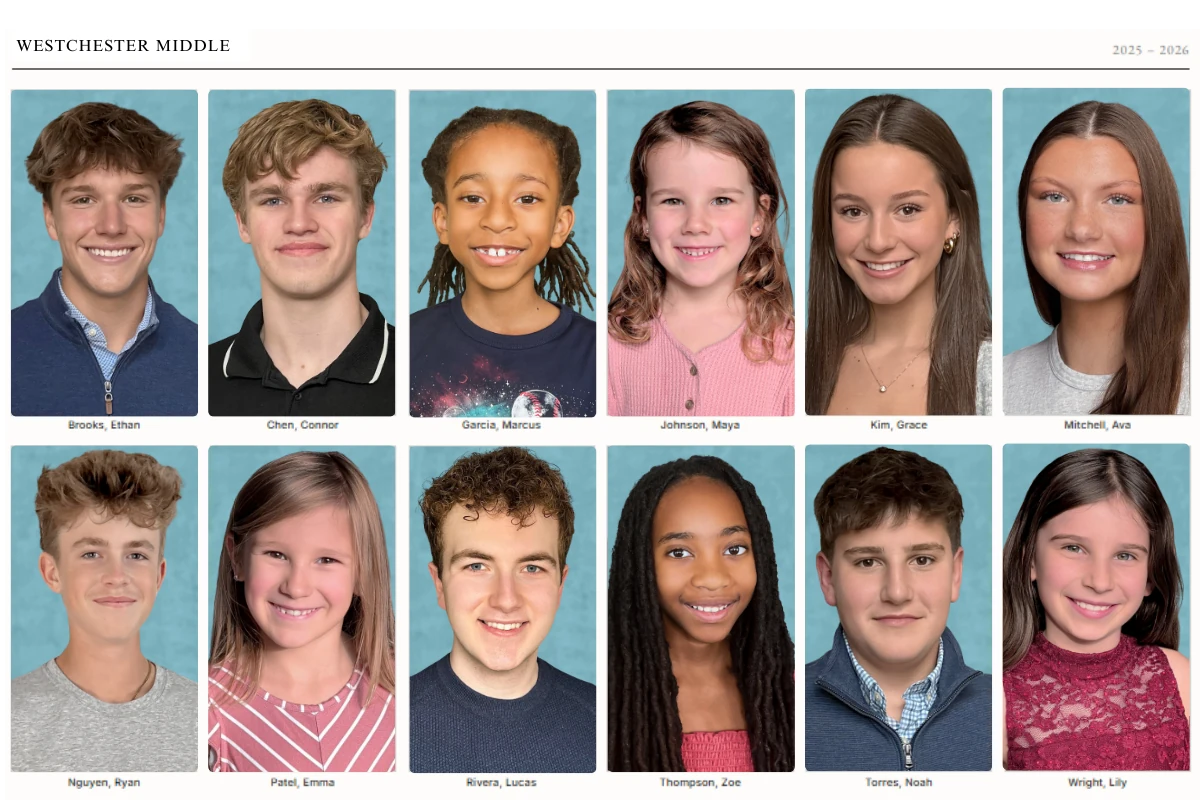
The step most districts skip is the one that matters most. A pilot means photographing one grade or one class with the prospective vendor — at no cost — and evaluating the results with real families in your district.
What to evaluate during the pilot:
- Photo quality. Are the portraits genuinely good? Would you hang them on your wall?
- Parent participation. What percentage of pilot families completed sessions and purchased?
- Parent feedback. Not just satisfaction scores — actual comments about the experience.
- Admin effort. How much time did your staff actually spend? Was it less than traditional picture day?
- Delivery timeline. Did the vendor hit their stated delivery window?
Any vendor worth considering should offer a free pilot. If they won’t let you test before committing, that tells you something about their confidence in the product. Our vendor comparison guide identifies which companies offer free pilots.
Try before you decide. Capturely offers free pilot programs — photograph one grade at your school at no cost. Real families, real results, zero risk. See 24-hour delivery and see-before-you-buy galleries firsthand. Request a free pilot →
Frequently Asked Questions
How long should a school photography contract be?
Most school photography contracts run 1-5 years, with 3-year terms being the most common for larger districts. Shorter contracts (1-2 years) give you more flexibility to switch if the vendor underperforms. Longer contracts may come with better commission rates or signing incentives. Whatever the length, include a termination clause with 60-90 days written notice — and specify annual performance benchmarks that trigger review.
What commission rate should schools expect from photography vendors?
Commission rates typically range from 15% to 40% of gross photo sales. The most common range is 20-30%. But the rate alone doesn’t determine your revenue. A vendor with a 20% commission and 60% parent participation can generate more total dollars than a vendor offering 40% with only 25% participation. Ask vendors for both their commission rate and their average parent purchase rate. Full pricing breakdown here.
Should we require a pilot program before awarding a contract?
Yes. A pilot is the most reliable way to compare vendors because it produces real results from real families in your district — not sales pitches. Photograph one grade with your top candidate at no cost. Evaluate photo quality, parent participation, parent feedback, delivery timeline, and admin effort. If a vendor won’t offer a free pilot, question their confidence in their own product.
What insurance should school photographers carry?
At minimum: commercial general liability insurance of $1 million per occurrence and $2 million annual aggregate, covering bodily injury, property damage, and contractor liability. Workers’ compensation at statutory limits. Sexual abuse and molestation coverage is required for any program involving minors. Your school should be named as an additional insured on the policy. Ask for a current certificate of insurance (COI) with the insurance company’s AM Best rating visible.
How do we evaluate photo quality from different vendors?
Don’t evaluate cherry-picked samples. Ask each vendor for a complete, unedited gallery from a recent session at a school similar in size and demographics to yours. Look for consistency across hundreds of students — lighting, posing, color balance, and retouching quality. Check that retouching looks natural and age-appropriate (some vendors have been criticized for removing children’s freckles and hearing aids). The pilot program is the ultimate quality test because it shows results with your actual students.
What data privacy requirements should be in a school photography contract?
Your contract should include: a FERPA-compliant vendor agreement designating the vendor as a school official, explicit data collection limits (name, homeroom, and student ID only), prohibition on selling or sharing student data, prohibition on using photos for AI training, a data retention and destruction policy, breach notification requirements, and background check compliance. Since 2014, nearly 150 student privacy laws have passed across 47 states — apply the most restrictive standard. Our FERPA guide covers the full requirements.
When should we start the RFP process for fall portraits?
Start in March or April. Allow 30-45 days for vendor responses, 4-6 weeks for evaluation and demos, and time for a pilot program in May. Aim to award the contract by June so the vendor can onboard during summer and be ready for fall portraits in September. If you’re replacing a vendor mid-contract, check your termination clause and notice requirements first.
What’s the difference between an RFP and a bid for school photography?
A bid awards the contract to the lowest price. An RFP awards it to the best overall value. Photography should always be an RFP process — because the cheapest vendor almost never delivers the best parent experience, highest purchase rates, or strongest data privacy practices. Several districts explicitly state their process is “a Request for Proposal rather than a competitive bid.” Use the weighted scoring rubric above to make the distinction operational.